
Model Reference
Electrolux EFMG527UTT Repair & Troubleshooting in Los Angeles
This page is a repair reference for Electrolux EFMG527UTT, categorized as a Dryer on the source model directory. A useful repair plan starts with the exact model number, then narrows the complaint by operating stage instead of guessing a replacement part from the first symptom.

Model number
EFMG527UTT
Appliance category
Dryer
About this model
Model overview
About this Electrolux model
This page is a repair reference for Electrolux EFMG527UTT, categorized as a Dryer on the source model directory. A useful repair plan starts with the exact model number, then narrows the complaint by operating stage instead of guessing a replacement part from the first symptom.
The purpose of this page is troubleshooting and service preparation, not retail specification copying. Do not fill missing information with features from a newer or visually similar Electrolux model. Use the rating label and model-specific documentation whenever a procedure, part number, electrical value, gas specification, or installation requirement matters.
For a Los Angeles service visit, send the model number and a photo of any display message with the booking request. That gives the technician a narrower starting point before arrival.
Start with what the appliance is doing
Before changing settings or resetting power, write down what the appliance is doing. On EFMG527UTT, useful observations include:
- Clothes take too long to dry — record whether airflow is weak, heat is normal, and the problem affects every cycle.
- Dryer tumbles but does not heat — record whether the drum turns normally and whether the complaint is constant or intermittent.
- An e-series or power code appears — record the exact characters and whether the code appears at startup or under load.
- Automatic cycles end too early or too late — record whether timed drying behaves differently from sensor-controlled cycles.
- Drum noise has increased — record whether the sound is scraping, thumping, grinding, or tied to drum speed.
- Dryer will not start — record whether the door is fully closed, the display is active, and Start produces any response.
The most useful description is chronological. Instead of “it stopped working,” note what started normally, what changed next, whether a sound or display message appeared, and which function failed to complete.
If the problem is intermittent, photograph or record the display before resetting anything. Intermittent behavior can disappear during a service visit, so preserving the sequence is part of diagnosis.
Homeowner checks that add diagnostic value
Work from the outside in. These checks are intended to rule out installation, loading, airflow, water, door, or simple power conditions without opening the appliance or bypassing safety devices.
- Confirm the door closes fully and no clothing is caught at the opening.
- Try a smaller normal load if the complaint occurs only with very heavy loads.
- Stop immediately if the plug, cord, outlet, or cabinet becomes unusually hot.
- Clean the lint screen completely.
- Inspect the accessible exhaust duct for crushing, disconnection, or heavy restriction.
After the safe checks, perform no more than one controlled retest. If the same symptom returns, keep that repeatable pattern for the technician instead of cycling power over and over.
Stop conditions
Stop using the dryer for a burning smell, sparks, repeated breaker trips, severe grinding, or an unusually hot plug, cord, outlet, or cabinet. Gas-dryer combustion and internal electrical testing require professional service.
These limits matter because a model page should help distinguish owner-observable checks from work that requires service access, electrical measurements, gas testing, refrigerant tools, or manufacturer diagnostic procedures.
What professional testing may cover
If the external checks do not explain the complaint, diagnosis on EFMG527UTT may move through the following component groups depending on the symptom sequence:
- Moisture and temperature sensing
- Heating circuit and thermostats
- Drive motor and drum support
- Main control and user interface
- Door-sensing circuit
- Exhaust airflow
That list is not a recommendation to replace those components. It is a map of systems that may need to be tested. A failed connector, harness, installation condition, supply problem, mechanical restriction, or secondary sensor can imitate a failed board or major assembly.
Diagnostic principle
The technician should verify the symptom first, reproduce it when safe, and then test the system that logically controls that stage of operation. Parts replacement should follow the measurement, not the other way around.
Error-code context for EFMG527UTT
If EFMG527UTT displays a code, record it exactly as shown before resetting power. Use the related Electrolux dryer error-code hub only as a starting point. A code should be linked to this model only when the control platform or model documentation confirms that meaning; Electrolux can reuse similar characters across product families and generations.
If a code disappears after one reset but returns during the same operating stage, treat that as an unresolved fault. The repeated timing often adds more diagnostic value than the fact that the display temporarily cleared.
Diagnostic focus
For EFMG527UTT, begin by separating clothes take too long to dry from dryer tumbles but does not heat. For the first symptom, record whether airflow is weak, heat is normal, and the problem affects every cycle. For the second, record whether the drum turns normally and whether the complaint is constant or intermittent. Those observations should be kept separate even if they occur during the same use cycle, because they may point to different systems.
If both symptoms occur together, note which one appears first. The sequence can determine whether the next service checks should begin around the moisture and temperature sensing or move first toward the heating circuit and thermostats.
This focused route does not mean those are the only possible problems on EFMG527UTT. It gives the page a model-specific troubleshooting direction without pretending that a component has failed before it is tested.
What to note for the service visit
- whether the symptom is constant or intermittent
- the operating stage where it begins
- any exact display message
- unusual noise, odor, heat, leaking, weak airflow, weak water flow, or abnormal movement
- whether the appliance had recent installation or repair work
- whether a normal power interruption or breaker event happened before the problem
- whether one safe reset changed anything.
Why exact parts identification matters
Use EFMG527UTT from the appliance rating label when looking up parts or service documentation. A symptom alone is not enough to select a control board, sensor, motor, pump, valve, heater, latch, fan, compressor component, or other major assembly.
Production revisions can matter. Before ordering a part, confirm the complete model identifier, any applicable serial or revision information, the diagnosed failure, and the correct service documentation.
Avoid using a replacement model's parts list or features to fill gaps. A current product that looks similar can have a different electrical architecture, control strategy, connector layout, or component revision.
When repair still makes sense
The repair decision should come after diagnosis. A targeted fix on an otherwise sound appliance may be worthwhile, while multiple expensive faults or deteriorated structural components can change the economics.
A professional estimate should identify the diagnosed fault and the proposed repair rather than presenting a generic list of “common parts.”
When professional repair is the next step
Schedule Electrolux dryer repair in Los Angeles if the safe checks are normal but the problem returns, the appliance cannot complete its normal function, or any stop condition above is present.
For EFMG527UTT, provide:
- model number: EFMG527UTT
- appliance type: Dryer
- exact symptom or error message
- when the problem occurs
- whether it changes after one normal reset
- any recent installation, electrical, water, venting, or service changes.
That information lets the service visit start with a model-specific diagnostic branch instead of a generic parts swap.
Common owner questions
Is one power reset enough to test EFMG527UTT?
One normal reset can help identify a temporary control event. If the same fault returns, repeated resets are not a substitute for diagnosis.
What should I provide when booking repair for EFMG527UTT?
Provide the complete model number, the exact symptom or display message, when it occurs, and the safe external checks already completed.
Should I order a control board or sensor for EFMG527UTT before testing?
No. Major electronic and sensing parts should be selected only after the fault is verified and the exact model/revision information is checked.
Why does the full model number matter for EFMG527UTT?
It determines the correct service documentation and parts lookup. Similar-looking appliances can use different controls, sensors, motors, valves, heaters, latches, or modules.
Electrolux EFMG527UTT repair in Los Angeles
If your Electrolux EFMG527UTT keeps showing the same symptom, book a model-specific diagnosis in Los Angeles. The repair process should verify the failed system, explain the findings, and confirm the proposed work before parts are installed.
Get it fixed
Recommended repair service
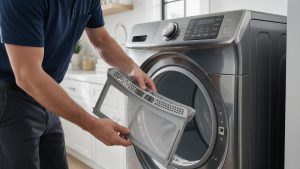
Electrolux Dryer Repair in Los Angeles
Electrolux dryer repair in Los Angeles for airflow, no-heat, long-cycle, motor, sensor, power, and E-series problems. Confirm coverage by ZIP.
Model-information disclaimer. Confirm your exact model number and specifications with your appliance documentation before booking a repair. Model pages are for identification and compatibility reference.
FAQ
Frequently asked questions
You submit a request with your appliance model and symptom, we confirm an appointment window, and a technician performs an on-site diagnosis. You then receive a clear estimate and decide whether to proceed before any repair begins.
Yes. We provide an upfront estimate after diagnosis. No parts are ordered or installed until you approve the work, so there are no surprise charges.
Replacement parts are selected for the exact model and confirmed with you before ordering or installation.
Service areas are listed on the Locations page. Contact us with your ZIP code to confirm current coverage for your address.
Book a repair
Tell us what’s wrong — we’ll take it from there
Share a few details and we’ll confirm an appointment. Prefer to talk? Call us and we’ll help right away.
Phone
(310) 361-3405
Email
electroluxla@gmail.com
Hours
Monday–Sunday: 8:00 AM – 8:00 PM
Service area
Los Angeles and Orange County
Request your repair
Fields marked with * are required.